DDD12 in 2015

DDD12 International Conference, 2015

Death, Dying and the Disposal of the Body (DDD12): “Eastern and Western Ways of Dying and Death”
Hosted by “1 December 1918” University of Alba Iulia, Romania
We are pleased to invite you to attend the 12th biennial ‘Death, Dying and Disposal Conference’ (DDD12) which will be held at the ‘1 December 1918’ University of Alba Iulia, Romania, between the 2nd and the 6th of September 2015.
DDD12 Flyer

DDD11 in 2013

DDD11 International Conference, 2013

CFP: 11th Death, Dying and Disposal Conference, September 2013
11th Death, Dying and Disposal Conference
The Open University, Walton Hall, Milton Keynes 5-8 September, 2013

We are delighted to announce that the eleventh biennial Death, Dying and Disposal conference will be held at The Open University, Walton Hall Campus in Milton Keynes between the 5th -8th September 2013 under the auspices of the OU’s Faculty of Health & Social Care and the Association for the Study of Death & Society (ASDS). We are arranging what we envisage will be a thought-provoking and innovative event which will once again bring together some of the leading international academics, practitioners and experts from across the arts, humanities, social sciences and clinical fields that make up the diverse arena of death and dying studies.

The Open University Walton Hall campus is situated within attractive grounds and provides a comfortable conference setting with all accommodation within walking distance.

Nearby attractions include the city of Milton Keynes which boasts an excellent shopping centre, new theatre and numerous restaurants, Bletchley Park, the famous code-breaking centre of World War II and iconic sculptures of concrete cows. Milton Keynes is also only approximately 40 minutes from London by train.

Dr Erica Borgstrom

Dr Erica Borgstrom

Dr Erica Borgstrom is an editor of Morality. She is Professor of Medical Anthropology at The Open University.

She specialises in researching palliative and end-of-life care from anthropological and sociological perspectives using a range of methods, including ethnography. As such, her work juxtaposes policy, practice, and people’s everyday experiences. Since 2020, she is the lead for Open Thanatology, an interdisciplinary research group at the OU that promotes the study and education of death, dying, loss and grief across the life course.

Erica is also a book series editor for Death and Culture (Bristol University Press) with Kate Woodthorpe and Ruth Penfold-Mounce.

You can find out more about Erica’s work here: http://www.open.ac.uk/people/esb79

Visit the Open Thanatology Hub for free educational resources: https://www.open.edu/openlearn/health-sports-psychology/open-thanatology

DDD16 International Conference, 2023

LSFDD conference venue was La Cittadella dello studente, located on the University of Padua’s main campus (Via Venezia, 8), in Padua’s city centre.

The plenaries, breakout panel sessions, refreshment and meals, book stall and publishers’ display were all be housed in the Psychology Dept.

The past three years have caused severe suffering around the world, from the Covid pandemic to the extension of wars and conflicts involving even countries that have been at peace for decades.

Long removed in many affluent countries, death has suddenly reappeared in the scenarios of our daily lives as a looming threat that requires constant attention to avoid it. All this while communities sought to reacquaint themselves with the meaning of dying and how to accompany the dying while respecting the right not to suffer.

This is a multi-disciplinary hybrid conference, and the theme Learning from Suffering, Fear of Death and Dying (LSFDD) invites responses not just concerned with reductionist perspectives, but also social change and the struggle for just cope with the consequences of a very long destabilizing period, to rebuild balance and overcome the crisis by learning from the pain suffered.

Trauma, loss, and uncertainty are not always synonymous of destruction, but can also offer opportunities for change that will restart the course of history toward a future of peace and prosperity, such as that for which humanity is constantly striving. All this is possible when people become fully conscious of the contours of the past.

The theme also invites researchers collaborating with, or operating on, the borders of academia and the conventional industry to share their experiences and visions and, in so doing, seeks to reframe challenge and disruption as potentially productive sites of future-making.


Located in Italy, where the challenges of the traumatic experience of pandemic and the fleeing of refugees from the territories of war run in parallel with the development of the humanization of the medical relationships with the sick and dying, offering new paradigms for thinking about the future also in the last phase of life, the conference invites participants to embrace our current moment of uncertainty, possibility, and challenge, considering the following questions:

  • What do grief from loss and trauma teach about life and how to improve it on an individual and societal level?
  • How can experiences of contact with death and dying be enhanced to set up more human and meaningful relationships?
  • How are well-being and peace intertwined with experience of death, dying in the construction of community?


Death, Dying and Disposal (DDD16), in Padua, Italy, thus seeks to contribute to key contemporary issues in Death Studies.

Firstly, this time of crisis may reduce the capability to think of future because of fear of death and anxiety. However, LSFDD could make it clear that the changes may open new perspectives and draws attention to emergent and transforming social, cultural, and relational practices in death care and commemoration.

Secondly, the theme was chosen to promote the future of the Association for the Study of Death and Society (ASDS) to include scholars working across Europe and the Mediterranean area.

Finally, the theme of suffering aims to engage more explicitly with academic fields beyond the humanities and social sciences, to include practitioners working in the area of loss for the promotion of resilience and hope.

DDD10 in 2011

DDD10 International Conference, 2011

DDD10 Press Coverage

From Conference Organiser Eric Venrux: DDD10 got nice publicity in the Dutch quality newspaper NRC Handelsblad of 13 September 2011. Please find the article attached. The article focuses on changes in Muslim burials in the Netherlands that are newsworthy. Both Khadija’s and Claudia’s research is discussed and they are extensively cited. Bravo Claudia! It is a timely and interesting article.

Note: The DDD10 conference was held in the City Centre at:

Concert De Vereeniging
Keizer Karelplein 2d
6511 NC Nijmegen 

The location is a concert building and all the venues are inside this building. There is one main location for the keynote lectures and general meetings and there will be four different venues, used for the panel sessions. All the rooms will be marked clearly at the conference. It is possible to use Powerpoint and to play music during your presentation.

Changing European Death Ways: New Perspectives in Death StudiesThe Tenth Death, Dying and Disposal Conference (DDD10) will be held at Radboud University Nijmegen, The Netherlands, on 9-12 September 2011 under the auspices of the University’s Centre for Thanatology and Faculty of Religious Studies, and the international Association for the Study of Death and Society (ASDS).

This international conference, held every two years since 1993, will continue to bring together academics and practitioners from many of the Arts-Humanities, Social-Sciences and Medicine-Palliative Care fields.

We look forward to welcoming you to the DDD’s first visit to Continental Europe and to Nijmegen, the oldest city in The Netherlands, where in 1678-79 a first step to European unification was taken when the Treaties of Peace of Nijmegen were signed. Still today, the Eurovision-tune is the prelude of the Te Deum that Marc-Antoine Charpentier wrote for this occasion. In this mood the conference seeks to contribute to a comparative framework to improve our understanding of the rapidly and radically changing death ways in the various countries of Europe and elsewhere.

Such a framework considering the resemblances and differences is both of scientific and practical relevance as regulations and institutional arrangements vary considerably and death can be expected to play an increasing role in the societies concerned because of several factors: an aging population, early diagnosis coupled with prolonged dying, rampant individualism, increased physical and social mobility, environmental degradation, and, most recently, the threat of terrorism and a pandemic. Furthermore, the provision of care for the elderly and dying is not secured, end-of-life decisions have become a hotly debated issue, traditional meaning systems crumble, new and more personalised forms of religiosity arise, and cemeteries are shrinking and difficult to maintain due the increase of cremations.

The overarching theme of the conference is mortuary variation in Europe and beyond.

Because dealing with death provides a valuable focus for comparative research on human experience and cultural life, in past and present, proposals are invited that relate to death, dying and disposal, drawing upon the resources of the disciplines embraced by the DDD. Papers are encouraged in religious studies, anthropology-sociology, archaeology, classics, history, philosophy, literature and art, and the medical fields associated with death, palliative care and grief, as well as in the fields of law, music, theology and spirituality.

The Centre for Death and Society, University of Bath, UK, and the Centre for Death and Life Studies, Durham University, UK, organised the last two editions of the Death, Dying and Disposal Conference, in 2007 and 2009 respectively. The Centre for Thanatology, Radboud University Nijmegen, The Netherlands, will host DDD10 in 2011.

DDD15 in 2021

DDD 15 International Conference, 2021

The 15th Annual Conference on the Social Context of Death, Dying and Disposal: Diversity and Decolonisation

Manchester Metropolitan University, UK

Wednesday 1st Sept – Saturday 4th Sept 2021.

Conference themes:

In increasingly fractured and confusing times, this conference seeks to promote an inclusive approach to death as the one intersection that truly touches us all. The covid-19 pandemic, the Black Lives Matter movement, Brexit, economic recession, the rise of right-wing populism and the re-emergence of culture wars are both shaped by and reproduce or seek to ameliorate deep inequalities at local, national and international scales. In this context, the conference aims to focus on forefronting issues of diversity and decolonisation in Death Studies.

In this spirit, we welcome papers and panels which focuson the following (non-exhaustive) list of possible topics, as they relate to death, dying and disposal:

  • Animals
  • LGBTQIA+
  • Race
  • Colonialism/decolonisation
  • Cultural appropriation
  • Environmental emergency and extinction
  • Grievability and bare life
  • Disability
  • Gender
  • Intersectionality
  • Representation(s)
  • Class
  • Economies
  • Neoliberalism
  • Migration
  • Inequalities
  • The post human
  • Radicalism
  • The covid-19 pandemic
  • New forms of care, solidarity, community and support
  • The role of technology eg. the internet, social media, online funerals, support networks etc.

DDD14 in 2019

DDD14 International Conference, 2019

DDD14 will be held at the University of Bath, Bath UK, 4-7 September, 2019.

The Social Context of Death, Dying and Disposal conference covers all aspects of death, dying, disposal, and bereavement. It is a multi-disciplinary residential conference open to all, including, but not limited to anthropologists, archaeologists, art and architectural historians, artists, bereavement counsellors, cultural theorists, critical race theorists, queer theorists, independent scholars, cultural geographers, deathwork practitioners, historians, literary theorists, medical and health practitioners, end-of-life and palliative care workers, philosophers, psychologists, students of religion, social policy analysts, social workers, sociologists, computer scientists, and those in the legal professions.

Taking place at a time when both academia and front-line practitioners are under increasing pressure to show ‘real world’ relevance and contribution, the theme of the conference is Engagement and Education. While focussed on death, dying and disposal specifically, it is envisaged that this broad theme will attract papers related to:

  • The role/purpose/possibility of death studies
  • The visibility of death as a social issue
  • Heritage, museums, and the cultural sector
  • Knowledge economy
  • Media work
  • Public education
  • Meaning of expertise
  • Experiential knowledge
  • Working with non-academic audiences/organisations
  • Historical and archaeological narratives
  • Political economy of death
  • The politics of death, dying, and disposal

The conference has been held every two years since 1993 and 2019 marks the 10-year founding anniversary for the Association for the Study of Death and Society (ASDS). The ASDS promotes the study of death in the arts, humanities, social and allied sciences and sponsors the DDD conferences. Abstracts (max 200 words) for conference papers are invited on any social aspect of death, dying and disposal related to Engagement & Education. As this is a multi-disciplinary conference abstracts need to communicate clearly with delegates from a wide range of disciplines.

DDD13 in 2017

DDD13 International Conference, 2017


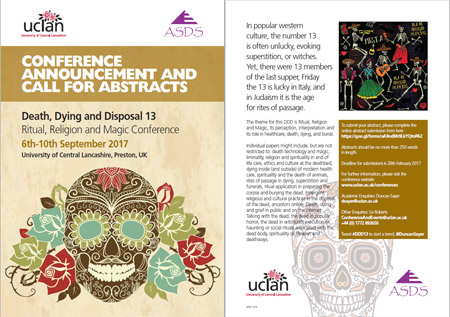
Death Dying and Disposal 13
Ritual Religion and Magic Conference
6th-10th September 2017
At the University of Central Lancashire, Preston

In popular western culture the number 13 is often unlucky, evoking superstition, or witches. Yet there were 13 members of the last supper, Friday the 13 is lucky in Italy and in Judaism it is the age for rites of passage. The theme for this DDD is Ritual, Religion and Magic its perception interpretation and role in healthcare, death, dying, and burial.

Individual papers might include, but are not restricted to:

  • death technology and magic,
  • liminality,
  • religion and spirituality in end of life care,
  • ethics and culture at the deathbed,
  • dying inside (and outside) of modern health care,
  • spirituality and the death of animals,
  • rites of passage in dying,
  • superstition and funerals,
  • ritual application in preparing the corpse and burying the dead,
  • emergent religious and cultural practices in the disposal of the dead,
  • ancestors online,
  • death, dying and grief in public and on the internet,
  • talking with the dead,
  • the dead in popular horror,
  • the dead in witchcraft execution or haunting or social rituals associated with the dead body,
  • spirituality or lifeways and deathways.

Awards Presented at DDD13

DDD17 International Conference, 2025

DDD17 Politics of Death on purple background with yellow crosses

We’re thrilled to announce that the next International Death, Dying & Disposal Conference (DDD17) will be hosted at the University of Utrecht, NL from Wednesday 27 to Saturday 30 August 2025.

The conference theme will be ‘The Politics of Death’ and you can find out more and view the full programme on the conference website. ASDS members receive a significant discount. Registration has now closed.